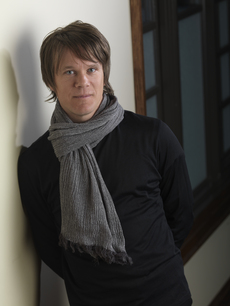
Showing posts with label Alexander Mickelthwate. Show all posts

Monday, March 26, 2018

All Good Things 3 Times!

Two contrasting pieces, two French composers, two conductors, add in one orchestra and the Winnipeg Philharmonic Choir, in one French cathedral and you have a wonderfully interesting week!

Two composers and their contrasting pieces are Francis Poulenc's Gloria, at once playful and stirring and Faure's melodious long-lined Requiem.  Monsieur Poulenc's score has some French cinema / restaurant style music coming from the orchestra.  It was composed in 1959.  At the first rehearsal I thought I would never be performance ready as the musical lines which are playful in performance are just unpredictable accidents in rehearsal.
Francis Poulenc
As an amateur singer, a score full of accidentals and multiple time signatures like this one just makes me fearful!  With some one- finger keyboard pounding at home and time spent with my best friend, www.cyberbass.com, I came to be able to playfully hum all the movements from the Gloria while going about my day.  It really is in my ear, head and heart now.
 In movement 5 I couldn't help feeling that I was walking in Paris at night, the Notre Dame Cathederal near me, crepe stands around the corner, a cabaret in sight and Edith Piaf singing in my ear.  As an overtrack to that comes the soprano plaintively calling "Domine Deus"  (Lord God) "Qui tolis pecata mundi"(who takes away the sins of the world)  Here in the French night, plaintively and uncertainly calling out for redemption.  It haunts me.  I challenge you to listen to the opening bars of movement 5 and see if you are not immediately brought to Paris. Other of Poulenc's movements, such as the 2nd are light and playful, with the composer having imagined monks playing football (soccer).  The light footwork, passing back and forth, and the joy of the game are evident.
Our soprano for this concert was Lara Ciekiweicz.  Lara has a dramatic singing style which immediately draws in the audience.  Lara has a charming practice of sending a card on opening night to the choirs she works with.  I find this to be a nice touch.  In her earlier life, before fame, she was a chorister alongside me with the Mennonite Festival Chorus.

Lara Ciekiewicz


Gabriel Faure  


The second half of the concert was the melodious and comforting Faure Requiem.  The popular Pie Jesu movement is perhaps the best known and is only soprano soloist and orchestra. Faure did write a beautiful requiem here but he really did not give much for the alto chorister to do, and there is no alto soloist either. In  2 out of 7 movements I was forced to stand there, score in hand and mouth closed for practically the whole piece.  In the Sanctus the altos sing only the last two bars, literally!!!!  Does he have unresolved issues with an alto and this is his way of dealing with them?   I don't get it!  Why make us stand there while the sopranos and the men sound so beautiful around us, clearly stating, ALTOS ARE NOT NEEDED and then at the last Sanctus, giving us one note to sing just to round out the chord.  HUMPFF!
The altos do have a nice duet with the tenors in Movement 2, that is, it could have been nice, but as our conductor told us after the first two performances, "Altos you are having trouble with intonation, well, sorry but you are flat, I have to say it, sorry."  Not exactly the thing you want to hear.  I am sure not much changed at the 3rd and last performance but our conductor was much too kind to tell us this.  Maestro Klaz has a firm practice of only stating the positive, once there is nothing left to be done.  He will teach and coax and reprimand right up until the last possible  moment of the last performance but once it is done, he has left it all on the stage and will insist that you were absolutely lovely!
So the very odd thing about this concert is that we performed it 3 times instead of the usual 2 and that we had 2 performance conductors.  This, I have never experienced.  The two conductors, Alexander Mickelthwate and Yuri Klaz  are quite different.  This was Alexander's last choral piece as WSO conductor and most likely the last time I will ever work with him.  Although he is a very pleasant man and not demanding of the choir, he is seriously lacking a downbeat and for this reason I am always nervous when performing with him the last 12 years.   In fact at the second performance the second movement, yes the one where the altos were flat, he was so seriously off the rails that the tenors, orchestra, and altos were all in different parts of the score.  So, this second performance was on a Saturday night, but earlier that same day we had a dress rehearsal with the other conductor, Yuri Klaz, whose tempos were quite different from Alexander's and whose conducting style is so much clearer.  It is a challenge to  rehearse so thoroughly with director 2 but perform a few hours later with director 1, then the next afternoon you are back with 2.   I heard from many choristers that they wish Alexander had attended the third performance as he would have heard a more passionate and much more accurate rendition of the concert.  There was no uncertainty on entries or endings at this last performance which was a big contrast to the other two.
Lara was the soprano soloist for the Faure and Matthew Pauls, the baritone.

All 3 concerts were sold out and this is a thrill to a performer!


Wednesday, April 1, 2015

Of Cake and Trumpet Jabs

Below I have re-printed the review from the Winnipeg Free Press of my latest completed concert even as my mind is looking towards the Good Friday Concert 7pm at First Mennonite church.  There we present Schubert's Deutsche Messe and Rutter's Requiem. 
 

I thought today I would take you behind the scenes of the Beethoven 9th concert to a view from my spot in the choir.  Like the fact that I was repeatedly being blinded by the baritone soloist's shiny shiny shoes.  The soloists for this performance were unusually placed i.e. they were not in front of the orchestra but rather relegated to stand with us  in the front row of the choir, on a little raised podium in case the shiny shoes and fancy gowns were not enough to let you know they were the soloists.  Mr. Baritone also owned a very nice collection of striped socks. ( His beautiful opening to the 4th movement of the Beethoven's 9th is wrongly credited in the review below to the tenor - which is a sad thing since tenors already receive more attention than is necesssary.) 
During this rehearsal I was disheartened to observe the little respect was given to the Maestro by the players.  Granted he does remind one of Peter Pan but he loves Beethoven and so we should allow him to present the Beethoven he wishes instead of opposing him every way we can. 
During one rehearsal "Unbirthday" cake was served for a returning viola player, the Maestro's baton landed in the cake at downbeat and icing was flung on face for beat 2.  So, yes it may be difficult to take seriously the instructions of a conductor with icing on his face but I was hoping they would at least try.
There was decidedly  much chit-chatting from the brass section during rehearsals, and I thought they would never be able to do this if Andrey Boreyko were still at the helm.  The withering words oozing over one who dared cross him is not a comfortable thing to witness. 
I will not reveal all the antics witnessed from this privileged position as some items are best left on the stage but will reveal one last moment that was quite comical. 
The third movement of the Beethoven's 9th is a beautiful serene piece that requires no trumpets until the very end.  During the performance, as we neared the end of it I see the 2nd trumpet player lifting his instrument from the stand preparing to play, he then suddenly jabs his trumpet into the tuxedoed leg of the principal trumpet player who jerks himself awake picks up his instrument and 3 beats later is playing beautifully.  The trombones and the first row altos shake with laughter as Beethoven goes on.


WSO brings the spirit of Beethoven to life

Standing ovation for inspired performance


There is some music that seems to grow only richer and more resonant every time you hear it -- and particularly when performed live.
Beethoven's Symphony No. 9 in D minor, Op. 125, popularly known as the Chorale, is one of those whose message of universal brotherhood based on Schiller's Ode to Joy has also grown more timely -- and more needed -- than ever.

CONCERT REVIEW
Winnipeg Symphony Orchestra
Masterwork
Beethoven's 9th
Centennial Concert Hall
Friday, March 27
Attendance: 1,234
Four stars out of five
The Winnipeg Symphony Orchestra's latest Masterworks concert held Friday night featured the stirring work with its last performance held in May 2013. The program led by Alexander Mickelthwate included guest soloists: Joni Henson (soprano); Elizabeth Turnbull (mezzo-soprano); John Bellemer (tenor); and Stephen Hegedus (bass-baritone) performing in both the evening's programmed works.
Also showcased were two of this city's busiest and hardest-working choirs this year: the Winnipeg Philharmonic Choir (Yuri Klaz, director) and the Canadian Mennonite Festival Chorus (Rudy Schellenberg and Janet Brenneman, co-directors).
The first of two weekend performances also caps the WSO's 2014-15 series of several concerts informally dedicated to human rights, in turn celebrating last autumn's long-awaited opening of the Canadian Museum for Human Rights.
It's always a pleasure seeing a conductor lead music from his homeland. The German-born maestro approached Beethoven's magnum opus with gusto and conviction, setting a brisk tempo during opening movement Allegro ma non troppo, un poco maestoso.
The following Scherzo: Molto vivace -- Presto hurtled breathlessly to its own double-bar close, including exuberant brass and bone-rattling timpani strikes.
By contrast, the Adagio molto e cantabile presented calmer vistas including mellifluous winds and noble horns evoking the peace of a German countryside. Still, this central movement that provides a measure of repose could have ebbed and flowed even more, before the trumpet fanfare toward the end that signals even greater things to come.
After the low strings' delicious opening statement of the principal theme that launches the finale, Bellemer introduced the chorale with his soaring, recitative evocation to "friends."
The four soloists presented as a remarkably well-blended ensemble throughout, with Bellemer a particular standout with ringing high notes and legato phrasing. Each singer only added to the whole gestalt in a satisfying performance.
It's one of classical music's most thrilling moments when the chorus dramatically rises for their first entry -- and this performance did not disappoint. Hearing the totality of the epic work's four movements unbroken by applause by a clearly enthralled audience would have only heightened its overall, cumulative power.
Nevertheless, those same 1,234 souls leapt to their feet at the end, awarding the maestro, WSO players and the full stage of choristers and soloists a rousing and well-deserved standing ovation.
The first half of the concert also featured Anton Bruckner's Te Deum, another mighty work composed in 1883-84 as a heartfelt hymn of praise and thanksgiving. It's one that isn't heard often in this city, with its last WSO performance in 1987.
Balance between chorus and orchestra is often very tricky with these types of concerts, akin to walking a musical tightrope. The choir's words could be clearly heard during the more lightly scored sections with strings; however they were often obfuscated whenever the brass came in it. They were at their best during the several a cappella sections.
Still, including this equally memorable work with its soaring choruses and "cathedral sound" added to the overall spirit and ethos of the inspired evening.

Republished from the Winnipeg Free Press print edition March 28, 2015 B5

Friday, July 25, 2014

Summer Fallow

Here I am in another summer dry season.  No performances nor rehearsals.  The usual depression was staved off by copious amounts of German beer
whilst cheering on the German team during World Cup 2014. I share three loves with Pavarotti:  music, food and football. (soccer to our North American minds)
Now that Germany has hoisted up the cup I must return to normal life and this, said normal life, is harder to bear without the sweet hours of rehearsal in it.
What is a chorister to do? 
Time to look ahead at the upcoming Season.
1.   First off will be rehearsals for church Advent concert, but I don't know what that will be yet. 
2. in mid December will be Handel's Messiah with Ivars Taurins!!!  I posted about this great Handel conductor in a previous posting and I am thrilled he is coming back and is working with our choir again.  Now that we know what he wants, his markings still relatively fresh in our minds, we will certainly be able to deliver a memorable performance.  Who can forget his unique musical marking of a squiggle over a group of notes.  Don't remember that from your theory classes?  Nope.  It is an Ivar marking meaning, "Do Something with these notes."  He also appreciates altos which gives him bonus points and clearly shows his worth as a conductor.  There will be two performances with the WSO, one will be a sing-along, which will have Ivars in Handel costume! Good times! 
3.  Britten's War Requiem in March with the WSO and Alexander Mickelthwaite, who, have I mentioned, is becoming better and better at conducting choirs and seeing that we are also part of the concert.  He has also raised his passion up a few notches and so I find him less Peter Pan-ish than I used to.  This will probably be the most challenging work for me in that it is not from the baroque or classical period and I have never performed, rehearsed, nor listened to this work.   The Symphony Orchestra season guide has this to say about it:
Using massive forces of musicians and singers, English composer Benjamin Britten had a message when he composed his War Requiem in 1961: “My subject is War, and the Pity of War. The Poetry is in the Pity...All a poet can do today is warn,” the title page shows in poet Wilfred Owens’s words, on which the work is portrayed. Owens was killed during the last days of World War I. Britten’s War Requiem is among the most powerfully eloquent testaments to Owens’s universal message of peace.
4.  Good Friday performance of Rutter's Requiem.  I have performed this once before but don't remember anything about it.  Last season our church choir performed the Rutter's Magnificat after which a conductor from the audience named us "the Rutter choir of Winnipeg", so I am confident that after many note slogging rehearsals we will be able to deliver a respectable version of this Requiem.

So what will this chorister be doing this summer? 
1. Sing along to favourite Arias in my living room just to know my voice is still there.  This last activity requires strategic timing, unless I don't mind my son bellowing in the background, "Turn that down! Stop singing!"
2.  Get a thrill when writing down rehearsal dates in my Calendar.  Might do this in two stages so as to prolong the pleasure.
3.  Listen to the two Requiems
4.  Perhaps order the Britten score

Tuesday, January 21, 2014

Larissa's Requiem - Valentin Silvestrov

 
Valentin Silvestrov
  I am in the midst of rehearsals for the Winnipeg Symphony's New Music Festival(NMF).  The NMF is a wonderfully successful venture on part of the Symphony - a week of merriment and showcasing composers from our time.
     Participating in the NMF is a "hit or miss" experience.  There have been some works where I have positively blushed performing them, wishing I were not inflicting this tripe on the audience but there have been times of supreme bliss, such as Arvo Part's Hymn to St. Cecelia a few years back.  Also, for me, the music for NMF is always difficult in that it is completely unpredictable and filled with dissonant harmonies, so that my limited musical abilities are highly challenged.
     This month I am very moved by the offering of Valentin Silvestrov, the Ukrainian composer, born 1937.  I have been rehearsing his Requiem for Larissa, which he composed from 1997-99 for his late wife.  He had thought at the time that this would be the last piece of music he would every write and indeed his complete heart and soul seem to be in this piece.  Like the other NMF pieces I have done it has been difficult to learn, perhaps the most difficult piece I have ever learned, and yet I am not turned away from it, instead I am at times weighed down by the force of his grief.
     The piece begins in a most profound way, the opening bar is a bar of nothing.  No choir, no solo, no orchestra, not a single instrument.  It is as though Valentin is saying, "My wife has died and now there is nothing."  This nothing is not a nice 4/4 nothing it is a very off-kilter 5/4 bar of nothing.  Yup.  Not only is there nothing to say, this nothing has unbalanced him.  The opening page contains 12 bars and the time signature changes 7 times!  See what I mean?  The man does not know how to walk through life without his wife. 
     The first word sung is "Requiem", the second is to be aeterna (eternal) and for 3 whole bars he tries to finish the word but can't, in the end the women sing only "aetr".  This device, of not being able to finish one's words, is used throughout the piece so that we as choristers are often left to sing only "a, oh, mm"; there is much humming and many a bar ends with an "mm".  All this fragmentation, and leaps and descents of 9ths contribute to the unsettling feeling that all is not right. For me the singer, it is a great task.  Often one does not get much support from fellow choristers either since in the 3rd movement the altos are divided into 6 parts!  One voice section - 6 different parts!!  Challenging, to say the least.
     In movement 4 we get some reprieve from this as  a lone tenor, from within the choir (as the instructions state) sings a complete poem by the poet Shevchenko, evoking a lovely Slavic melody filled with beauty and pathos, although even here the time signature keeps changing so that I can rarely look off the page, even though the altos are now only in 4 parts. 
     The 5th movement echoes Mozart and it is so" Mozartarian pretty" that it is difficult to believe the master himself did not write it.  A lovely, lovely piece of music played in turns by a solo violin or solo piano while the choir attempts to sing the Agnus Dei, but all the accidentals, fragmented words and time signature changes make this difficult, but there is much encouragement and comfort in the beauty of the solo violin and piano.  The 6th movement is much like the first and then the 7th and last movement contains 90 bars of mostly orchestration; 4 bars have the choristers singing "Requiem Aternam" this time finishing the word, although the altos are not yet ready to speak and say only (o) for 7 beats and then 5 beats all alone on our (m).
     We have had our first rehearsal with the performance conductor, Alexander Mickelthwate, and I was surprised at how much he seemed into this piece.  With all the running around he has had to do rehearsing and learning new music he seemed to have a special place in his heart for this work.   He gave the choir some brilliant instruction and I feel the piece is really coming along.  We have 3 orchestra rehearsals now and then - Ta Da- it will be performance time.  Here is the link for the NMF website.  http://www.newmusicfestival.ca/wp/ 

Wednesday, May 8, 2013

Beethoven's 9th with Alexander Mickelthwate and WSO

The Ode to Joy.  Loud, high joyful.  Fast, screaming beautiful.  Uplifting whirlwind transcending our human problems.  Freude schoener Goetterfunken Tochter aus Elysium.  Freudig wie ein Held zum Siegen!   Powerful and spiritual and so popular it is used my many a comedy sketch.  Seen here if you click on Sesame Street  and of course done here by the hilarious Mr. Bean.
It is monumental and yet  I feel that the we as a choir are oblivious to that fact.  We are doing some monumentally sloppy singing.  Consonants in the wrong places, words pronounced incorrectly notes sung at the wrong time and we have even managed to belt them out at the wrong pitch.  Not sure what is going on, and I am not sure I have ever been in this situation.  That is, where there have been so very many errors by so very many people this close to performance.
Tonight we rehearsed with the orchestra and I really don't think we were heard over all that Beethoven blasting in front of us, which is just as well.    Ironically I did not see too many smiling faces in this Ode to Joy rehearsal - even the man tinkling away on the triangle looked slightly angry.  Alexander gets full points for trying - he smiled as he perched pixie-like on his podium and I felt sorry that we were not giving him much.
We have a dress rehearsal tomorrow and then it is 3 days of performances.  I really hope something or someone will whip us into shape.  Where is Jane Glover's withering gaze when you need her?
In the end it will be Ludwig himself who will rescue us, his writing genius will be able to transcend our inadequacies. (I hope)


Monday, April 2, 2012

Mickelthwate in Harmony with Brahms

     Yesterday we had our first rehearsal with our performance conductor, Alexander Mickelthwate.  It was a piano rehearsal only so no orchestra to get in the way of the choir and conductor.  In the lead-up to this I tell some new comers to the choir that Alexander does not make too many demands on the choir and will most likely pronounce everything "good, good, good", the Maestro shows up and begins to surprise.
      The first surprise is how excited he is about Brahms!  He said it is in his top 4 favourite list.  The first change he makes is in our opening bars.  He wants it much slower than we have been rehearsing it and with  much more patience and emotion. We repeat the opening bars several times until it is perfected  . He really brings out the romantic elements of the piece, which of course is the whole point of Brahms!!  Brahms is forever yearning and it was nice to have our performance conductor keep reminding us to "be patient, take your time, take lots of time."  Usually conductors are saying "even though you are singing piano you must keep the tempo" or  "don't slow down just because it's a low dynamic"  etc, etc. so we are used to our internal tickers moving us along but here, with Alexander Mickelthwate we were given permission to sink into it and take all the time we need to sing with feeling, "Selig sind die da Leid tragen".
     Another wonderful surprise is that he had us change many of our vowel sounds.  We had rehearsed with a straighter brighter vowel and - hip hip hooray - the Maestro wants us to use a rounder vowel.  Not too much "a" in Selig.  The rounder vowel suits us much better! 
     Surprise number three was that when the Altos sing out the theme, "Herr, du bist Wurdig" he did not ask for a lighter sound as some conductors request.  He wanted a robust, dark alto sound, which of course is what we altos do best so we are in perfect agreement.  He also did not seem surprised that the Altos were given so many themes to sing but conducted us as if it were our natural right to belt out the significant texts!
Alexander gave full permission for the Altos to be Altos and to deliver all that Brahms gives us.  I could feel Brahms smiling too!
Now on to 3 rehearsals with the orchestra and then performance on Saturday Night at the Centennial Concert Hall.

Thursday, March 15, 2012

Beloved Brahms

On Sunday The Mennonite Festival Chorus 2011/12 rehearsed Brahms Requiem.  Ah!  Sigh!  To say I love Brahms would be the whole truth and nothing but the truth.  I do not only love his music, I love him.  Furthermore, Brahms loves me.  Brahms fell in love with several women in his life, and unlike the loves of Mozart, Brahms yearned for Altos!!  Yay!!   When does that ever happen?  It is very simple really.  I love Brahms because he first loved me. The fact that our conductor is married to a soprano was evident when during rehearsal  he asked,  "Why does the theme begin with the altos again?"   Oh Dear. 
In the Requiem Brahms presents the alto chorister with some of the most beautifully haunting lines to be found in choral music.  He lets them sing several passages alone!  He gives them a range of notes from the G below middle C to the E flat on top of the treble clef.  He has faith in the alto to navigate this wide range. 
The Brahms Requiem is a work that spoke to people from the very beginning. At it's premier in Bremen, Good Friday April 10th 1868, it was a huge success. It is reported that tears were flowing during the 4th movement and the audience left the cathedral with feelings of "awe and grace." (from Johannes by Swifford)

In fact, the Requiem spoke to people even prior to it's premier.
" In August 1866 Brahms was in Baden-Baden with Clara (that being Schumann) and her children.He finished the requiem except for the 5th movement which was an afterthought following the premiere.
On a memorable September afternoon at Clara’s house he played and sang through the whole piece. Clara noted in her journal “Johannes has played me some magnificent numbers from a German Requiem…I am most moved by the Requiem: it is full of thoughts at once tender and bold. (p.309 Johannes)

I was touched by a reference to the Brahms Requiem in a book by Oliver Sacks called Musicophilia, Tales of Music and the Brain.  In the following passage the writer had lost a good friend (Lenny) to death but had never mourned this.
The performance of Brahms Requiem had a powerful effect on me. I went to Berlin thinking I would write about David Hume there..but..as the waves of music poured over me- listening with my whole body, it seemed, and not just my ears - I realized I was going to have to write about Lenny instead. I had been carrying Lenny's death in a locked package up till then, a locked frozen package that I couldn't get at but couldn't throw away either..It wasn't just Lenny that was frozen; I had too. But as I sat in the Berlin Philharmonic Hall, and listened to the choral voices singing (Brahms) something warmed and softened in me. I became, for the first time in months, able to feel again.

I feel this power of Brahms at every rehearsal and am usually on the verge of being overwhelmed by it during performance.  Two more rehearsals before we work with Alexander Mickelthwate on it.  I have performed the Requiem many times but this will be my first with Mickelthwate.  I am expecting him to be his usual non-demanding amiable self.  Performance at the Winnipeg Concert Hall, on the Saturday between Good Friday and Easter.

Sunday, October 16, 2011

James A. Richardson International Airport Opening

     A performance like no other.  Choir and Orchestra drive to certain shopping centre where they are put on buses and driven to the new James A. Richardson International Airport.  After we passed the security gates, we were ushered into the new facility, which I must tell you is gorgeous!  I would say it is the best part of Winnipeg.  I think we should just keep the tourists here for their entire visit. 

     Choir and Orchestra are then put behind a black curtain, which we learned is actually called a  kabuki.  At dress rehearsal there was much talk of the kabuki and the accurate dropping of it.  The poor sod assigned the task of doing the kabuki drop appeared to feel the pressure and needed the dress rehearsal, which was earlier this day.  He wanted to watch the Maestro's downbeat several times so he would be sure to drop it at the right time.
     Now at Performance time we can hear Tom Jackson's deep voice inviting Winnipegers on board. and when he intones, "Ladies and Gentlemen prepare for take off"  the Orchestra, from behind the curtain begins the dramatic Strauss"also sprach zahursta"  As that ends Alexander Mickelthwaite gives the downbeat for "O Fortuna" (the opening number in Carmina Burana) and the nervous kabuki string puller drops the curtain and a collective gasp is heard from the crowd as chorus and orchestra launch into the work.
   In the interests of time the flirting number where the sopranos beg to be looked at was dropped.  Poor girls.  The Robust, "tempus est iocundum" was left in and this is where baritone soloist.  Mel Braun  did a whole-hearted job that increased every one's enjoyment of the piece!
   The choir was in fine form, most notable were the sopranos who are asked to come up with several high B's at a piano dynamic. They did it in most ethereal fashion
     Although we were singing for the Prime Minister, Mr. Stephen Harper, we didn't actually see him as the stage lights were much too bright to see him during our performance and as it was a high security affair we were whisked on and off the stage like the hired help we were and could not so much as say, "good evening" to the man.   The last time I sang for a Prime Minister I was 10 years old, and at that time I actually saw and spoke with the man.  That man was....aw shucks, I'll let you guess.

     Thus ends my first performance of excerpts from Orff's Carmina Burana.

Tuesday, October 4, 2011

First Orchestra Rehearsal - Carmina Burana

Yippee!  I thought I was having fun rehearsing this before, but last night with the orchestra I actually got the giggles!
The part where I feel like I am singing in an Italian Restaurant was even more hilarious with full orchestra backing and I mean full orchestra.  All the horn players, a piano and even Mr. Triangle Man was there klinging away. 
Alexander Mickelthwate requested more words from the choir which is rather amusing since there is not a word in it that any audience member will know, but yes I realize that good enunciation will add greatly to the crispness of the performance but I feel like giggling when I am seriously and accurately singing out, "Na za za" which is a nonsense word even in the Latin/German mix we are singing.
Alexander confessed that his favourite part of the piece is when the Sopranos are singing, "Seht mich an"  (Look at me), this follows the part where all the women are asking for their make-up to help attract a man.  Once the make-up is applied it is left to the sopranos to call out for attention while the Altos have given up.   The Orchestra sounded great and appeared to be having as much fun as the chorus, there were smiles all around.  In the end Alexander,  in usual fashion, pronounced it all "good, good, good."
One more rehearsal at the airport itself, and then the performance.

Monday, October 3, 2011

Carmina Burana

The first  performance of the new choral season will be at the official opening of the James A. Richardson International Airport in October 2011.   We will be performing selected works from Carl Orff's Carmina Burana together  with the Winnipeg Symphony Orchestra conducted by Alexander Mickelthwaite for an audience of invited guests only, so I can't even sell you a ticket.  For security reasons we will be brought in by bus, not sure if they will issue fake nose and glasses.
The Songs of Burana or Carmina Burana are poems that were found in a Bavarian monastery in 1803 but the poems were written way before that in the 11th and 12th centuries.  Before you get the wrong idea let me say there is nothing monk like or spiritual about these poems.  Our choir is only performing excerpts from it but I have not encountered anything sacred in it.   It is a fun sing with some bawdy lyrics.
Speaking of lyrics., they can be a bit challenging.  Some of the poems are in Latin, some in a old Bavarian style German which hardly resembles classic High German in any way.  Our conductor spent some time living in Bavaria and although he spoke High German he could not speak with his landlady as she spoke only Bavarian German which sounded like gibberish to him.

In No. 8 Carmer, gip die warwe mir" (Friend give me the paint)  we women are to act like 18 year old flirts as we ask our friend to pass the paint so we can make up our face and attract a young man.  This is all fine and good for the college kids amongst us,  but when you get to my age  all the paint in the world can't help in that department so the lyrics feel ludicrous.  Women my age should not be batting their eyelashes in public and any come hither looks coming from my part of the alto section would have our young tenors running the other way.  Still we try.  Of course it is the Sopranos who at the end of each verse sing out "Seht mich an jungen man"  (Look at me young man) oh brother - sopranos; always clamouring for attention.

No. 1 and No. 10  the O Fortuna Choruses, are by far the most common numbers in this work.  Many a movie score has used them and advertising as well.  At the first rehearsal I just felt foolish singing this but by now I feel rather part of an epic.

All this music to these old poems was written by Carol Orff.  The music is not difficult and the excerpts we are singing do not have much subtlety to them but it is great fun to sing in a raucous fashion.

In the No. 22, Tempus est iocundum, there is a section where I feel like I a singing in a cheesy Italian restaurant with red and white checkered cloths on the table and Chianti bottle candle holders in the middle of each table.  There is a moustached accordion player beside me, smiling broadly.  I have way too much fun singing this part and am quite surprised my conductor has not told me to shut up - yet.

Does this music speak to my soul?  No.   Does it overwhelm me with it's beauty?  No.  Am I having fun? 

Tuesday, May 17, 2011

"Oh, ya, I know him."

     An interesting fact about choral conductors is that while a chorister gets to know the conductor and feel connected to him a conductor cannot be connected to the individual chorister, only to the choir as a whole.  For example, I go around saying I have worked with Jane Glover and Bramwell Tovey, and Boris Brott and I feel like I have an acquaintance with them, but does Maestro Brott ever tell his buddies, "Did you know I worked with Lori in Winnipeg?"  How many times do you think Bramwell Tovey has told his dinner companion, "Lori and I have done the Beethoven's 9th several times."  The truth of the matter is that none of these conductors would  know me if they tripped over me on their way down the concert hall stairs.
      Of course, in smaller choirs like the church choir your conductor can choose to get to know you and your rehearsal conductor for the visiting superstar conductor may also be someone who knows his individual chorister, but even then, he is working with the choir not the singer.  The sound he is shaping is the choirs.
Bramwell Tovey
     I thought I would share a bit about these conductors I "know".  Bramwell Tovey, for example, is the director of the Vancouver Symphony Orchestra.  When he was the conductor of the Winnipeg Symphony Orchestra I worked with him several times.  Together we did the Beethoven's 9th twice (and I was pregnant both times so when I was called up to do the 9th a third time I thought, "Oh no, am I pregnant again?)  I have also sung the Sea Symphony with him.  Bramwell, oh of course I am on first name basis with this conductor, is an easy conductor to work with.  He is wonderfully animated and relates humorous anecdotes with his wonderful English accent accent and vocabulary. He tells stories of his school days in England, his Mennonite in-laws, and his children, all with such wonderful warmth.  When I have worked with him as part of a Mennonite choir he will even use some low-german words which are incomprehensible when spoken with an english accent, but the attempt is endearing nontheless.  (How can I not feel like I know him when he reveals so much of himself?)   His whole body is involved in all he tells.  I so loved the time he was rehearsing the Verdi Requiem with the Mennonite Festival Chorus and in the Dies Irae section he was trying to get us to sing the "Quantus tremor est futurus, quando judex est venturus" in a diabolical whisper.  He hunched his back, curled his fingers bringing his hands up near his face, bent his knees and began to tip toe towards us, hissing "Quantus tremor est futurus..."  That evil troll image pops into my head every time I hear or sing that phrase in the Verdi. 
       Boris Brott was also somewhat playful.  I worked with him for the locally infamous 500 voice Handel's Messiah in the 1980's at the, now torn down, Winnipeg Arena.  This performance was known more for the squeaky bleacher seats every time the choir rose and sat than for the singing.  He was easy to follow, had an animated face and took the whole thing as a lark.  I don't remember him taking one part of text seriously and when we sang "All we Like Sheep" he said it reminded him of the Woody Allen movie,  Everything You Always Wanted to Know About Sex  where it seems some people do like sheep.
 Then there was Andrey Boreyko with whom I have worked on several pieces.  We (yes, "we", just ask him) worked on Brahms Requiem, Arvo Pärt's  Cecilia, vergine romana,Patrick Carrabré  Creation Stories, Beethoven's 9thDvorak's Stabat Mater and probably more that I can't recollect.  Boreyko was more god than human.  He glided to the podium, the respect coming to him from the orchestra was palpable, he spoke in a German accent and we hung on his every soft word.  He was demanding but made us eager to please.  As you would expect from a god, he was not revealing.
      It is impossible for me to imagine he would have an every-day life to talk about.  I cannot picture him going shopping or mowing the lawn.  If I were to picture him off the podium it would be in black turtleneck sweater, cigarette in hand, brandy glass on table, poring over scores. and periodically pushing his hair off his face.  He is not of our world, and the passion he brings for the music is overpowering. Working with him ranks in the top of my choral experiences.  After a performance with him one feels as though they have been on a journey to another world and have returned shaken to the core and emotionally spent.
     However, he can be very cutting in his remarks.  I remember shaking on my riser as, during a rehearsal of Stabat Mater by Dvorak, Boreyko lambasted the timpani player accusing him of having arrived without a sense of rhythm when he couldn't mimic a heartbeat. For many uncomfortable minutes the poor sod had to pound it out and then be met with a withering look from Boreyko. When Boreyko looks at you his gaze cuts right through you, leaving one quite weak kneed, for better or worse.
 Maximiano Valdes
    The opposite is true of the Chilean conductor Maximiano Valdés.  He most certainly thinks he is God but he is the only major conductor I have worked with who failed to move me at all.  He gave me nothing.  From him I learned that it is extreme torture to sing with someone who is not exuding anything.  He was robotic and uninspiring and it was such a great disappointment as he came with such an impressive discography.  When we met him for the first time I thought maybe he was sick and that by dress rehearsal he would give us something.  Nothing.  I worked and worked during the performance but felt nothing.  The performance was utterly unsatisfying.  This was sad as the work we sang, Mozart's Requiem, is one of my favourites but Maestro Valdes was so cold that even Mozart could not penetrate him.  This performance was the first and last one where I have cried tears of disappointment.
Alexander Mickelthwate

     The major conductor I work with the most these days is Alexander Mickelthwate who is a look alike to Kevin Bacon.  He is a complete delight to work with and together (ha, ha) we have performed Beethoven/s 9th, Beethoven's Choral Fantasia, Beethoven's Mass in C, Beethoven's Missa Solemnis, Verdi's Requiem, Haydn's Creation, Brahms Requiem.  He speaks to us with an exquisite soft German accent.  He is complimentary and not very demanding of the chorus.  He is tiny and boyish as he perches on the podium like a sprite and I always have the distinct feeling that I am being led by Peter Pan. He is exuberant and bouncy during performance and makes the whole experience enjoyable!  My most memorable Mickelthwate moment is that he gave in to a rehearsal conductor.  In my experience the performance conductor always over rules the rehearsal conductor.  The general rule is that anything you may have rehearsed in the lead up weeks can be changed the first time the performance conductor meets you.  During the Verdi Requiem there are 7 bars that the altos love to sing.  They occur near the end of the piece when they interrupt a Soprano soloist and steal the show by singing in operatic fashion, on a C above middle C,  all by themselves, 'LIBERA ME DOMINE DE MORTE AETERNA IN DIE ILLA TREMENDA".  This is how we rehearsed it, this is how we wanted to do it.  Imagine how our hearts sank when at rehearsal with orchestra Alexander tells the Altos to just sneak in quietly , hardly noticeable.  What?  Hardly noticeable?"  That is what we have been doing our whole lives,  we can do that but surely not here, not in these 7 bars when we are so longing to shine.  Of course, being choristers and not divas, we dutifully whispered our Libera Me.   When leaving the rehearsal hall an alto friend and I were confronted by Yuri Klaz, our rehearsal conductor, who furrowed his brow and spat out, "What happened to you Altos?"
 "Just doing what the Maestro instructed", I said. 
"No,  no", he shook his head, " this cannot be." 
Just then Mickelthwate appeared and with score in hand Klaz attacked him and I swept out the door.     
     At dress rehearsal the next day I could have shouted for joy when the instructions from the podium were, "Okay, altos sing it like you rehearsed it!"
    
     Other major conductors I have worked with have been discussed in older postings here on this Blog.  Jane Glover and Noel Edison.  Edison in the Handel's Messiah posting and Glover in the posting called Jane Glover and the St. John's Passion.